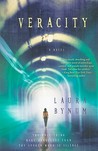
 Veracity by Laura Bynum
My rating: 2 of 5 stars
Let me just start off by saying that I really wanted to like this book. It has an amazing concept and I'm pretty much a sucker for Dystopian Futures. I'm such a sucker that it's really hard to mess it up for me.
The problem with this book isn't necessarily the over detailed technology of this future, like I read in some reviews. I actually kind of enjoyed that aspect of it. The concept is golden: Certain words are red listed and will cause a plate in the back of your neck to short out and potentially kill you. Words have the power to carry ideas and when you're brainwashing an entire society, you find a way for them to not say them. Harper, the main character, is a sentient (or psychic) so they use her to find potential threats. The relationship between Harper and her daughter, Veracity, is done well, if obviously. Wanting to join up with a resistance based on the fact you can't say your daughter's name anymore making you realize how much society's given up. It's an exceptionally well written book. When you're dealing with a book about language, having someone with a firm grasp on it is definitely a plus. These are the good points and cover about the first half of the book.
Now the bad:
The main thing that killed this novel for me was the interpersonal relationships between Harper and everyone who wasn't her daughter. The relationships develop in ways that just don't make any sense whatsoever. She's in love with John who she initially hated. I can't figure out why, other than the author apparently felt that some kind of love story was desperately needed. Personally, the story would have been better without it. Her friendship with Ezra is no less mystifying. Ezra can't stand her and says she's the worst kind of whore. And then she's doing Harper's makeup. Um, kay?
The other problem for me was that it beat you over the head with the concept that this is clearly a post 9/11 metaphor. The Pandemic and the resulting control used over the population are clearly about 9/11 and the Patriot Act. Which is all and good, but by the sixth time you've gone into detail about it, I promise you the slowest reader has gotten it. Or if they haven't they're not going to.
There's also the whole way the war goes about. Call it a flaw in me, but the good guys have no business winning in a dystopian future. It takes away from the fear of it happening and the general air of hopelessness that tend to permeate the stories. But I'll give that part is just me.
View all my reviews

No comments:
Post a Comment